Arena: AI-Sales Coach

AI-simulated buyer scenarios so reps can practice objection handling and improve closing skills.

Company

Clipboard Health

Scope

MVP definition → conversation UX → practice + feedback loops

Role

0→1 product design. Shipped MVP in 6 weeks. Core conversation UX, practice session flows, and rep dashboard.

Engagement

Retainer

Diego has been a standout product design partner. He challenges assumptions with thoughtful debate, moves quickly from discovery to clear deliverables, and takes real ownership of direction and decisions. He’s highly collaborative and brings strong AI UX thinking around conversational flows, guardrails, and explainability.

Diego has been a standout product design partner. He challenges assumptions with thoughtful debate, moves quickly from discovery to clear deliverables, and takes real ownership of direction and decisions. He’s highly collaborative and brings strong AI UX thinking around conversational flows, guardrails, and explainability.

Diego has been a standout product design partner. He challenges assumptions with thoughtful debate, moves quickly from discovery to clear deliverables, and takes real ownership of direction and decisions. He’s highly collaborative and brings strong AI UX thinking around conversational flows, guardrails, and explainability.

Luiz Lima

Luiz Lima

Luiz Lima

AI Team Lead

AI Team Lead

AI Team Lead

Problem + My role

Most sales training breaks at the exact moment that matters: when a rep gets interrupted, challenged, or pushed into a hard objection. Arena needed to make practice feel like a real call and make feedback specific enough that reps improve on the next attempt.

What I owned

  • The conversation interaction model (how practice works end-to-end)

  • The guardrails that keep AI guidance helpful without breaking flow (timing, “loudness,” interruptions) 

  • The feedback system that turns a call into repeatable improvement (not a one-off score

Problem + My role

Most sales training breaks at the exact moment that matters: when a rep gets interrupted, challenged, or pushed into a hard objection. Arena needed to make practice feel like a real call and make feedback specific enough that reps improve on the next attempt.

What I owned

  • The conversation interaction model (how practice works end-to-end)

  • The guardrails that keep AI guidance helpful without breaking flow (timing, “loudness,” interruptions) 

  • The feedback system that turns a call into repeatable improvement (not a one-off score

Problem + My role

Most sales training breaks at the exact moment that matters: when a rep gets interrupted, challenged, or pushed into a hard objection. Arena needed to make practice feel like a real call and make feedback specific enough that reps improve on the next attempt.

What I owned

  • The conversation interaction model (how practice works end-to-end)

  • The guardrails that keep AI guidance helpful without breaking flow (timing, “loudness,” interruptions) 

  • The feedback system that turns a call into repeatable improvement (not a one-off score

Key decisions

Key decision 1: Scenario creation can’t feel like filling out a form
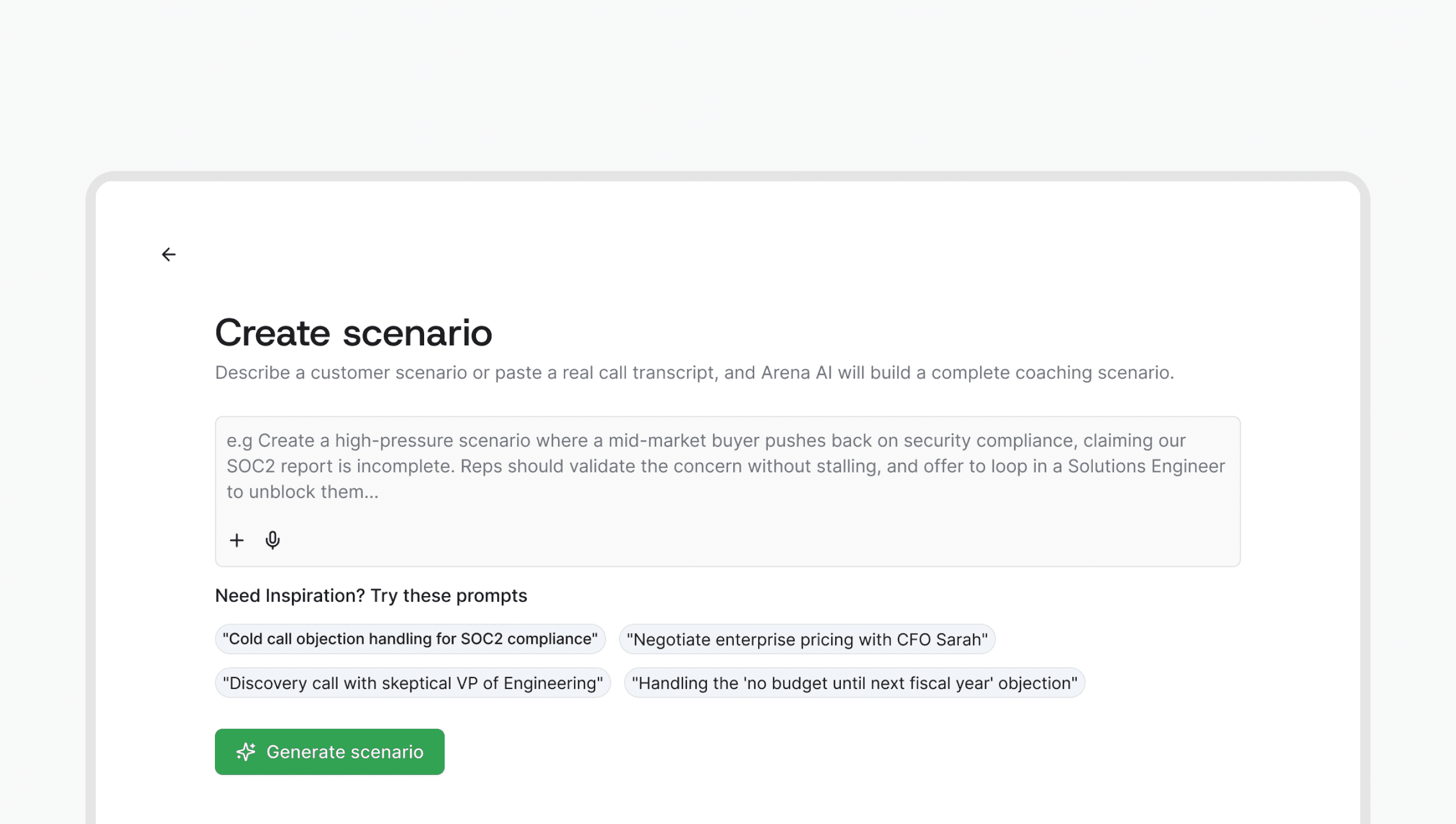
A major adoption risk was making scenario creation feel like admin work. Arena keeps the AI assistant in-context, so managers can describe scenarios in plain language and refine them with lightweight controls (tips frequency, mood, voice).

Key decision 2: "Barge-in" guidance during the moment without breaking the flow
Arena leaned into “barge-in”: guidance during the call while keeping conversation natural. That forced careful choices around when to interrupt, how prominent guidance should be, and how to keep reps in flow. 

Key decision 3: Make uncertainty visible during practice
In real calls, reps read tone and tension. In simulations, they can feel blind. I introduced the thermostat concept: a persistent signal showing how the conversation is trending, paired with transcript visibility so reps can adapt in real time.

Key decisions

Key decision 1: Scenario creation can’t feel like filling out a form
A major adoption risk was making scenario creation feel like admin work. Arena keeps the AI assistant in-context, so managers can describe scenarios in plain language and refine them with lightweight controls (tips frequency, mood, voice).

Key decision 2: "Barge-in" guidance during the moment without breaking the flow
Arena leaned into “barge-in”: guidance during the call while keeping conversation natural. That forced careful choices around when to interrupt, how prominent guidance should be, and how to keep reps in flow. 

Key decision 3: Make uncertainty visible during practice
In real calls, reps read tone and tension. In simulations, they can feel blind. I introduced the thermostat concept: a persistent signal showing how the conversation is trending, paired with transcript visibility so reps can adapt in real time.

Key decisions

Key decision 1: Scenario creation can’t feel like filling out a form
A major adoption risk was making scenario creation feel like admin work. Arena keeps the AI assistant in-context, so managers can describe scenarios in plain language and refine them with lightweight controls (tips frequency, mood, voice).

Key decision 2: "Barge-in" guidance during the moment without breaking the flow
Arena leaned into “barge-in”: guidance during the call while keeping conversation natural. That forced careful choices around when to interrupt, how prominent guidance should be, and how to keep reps in flow. 

Key decision 3: Make uncertainty visible during practice
In real calls, reps read tone and tension. In simulations, they can feel blind. I introduced the thermostat concept: a persistent signal showing how the conversation is trending, paired with transcript visibility so reps can adapt in real time.

Success criteria and measurement plan

For an MVP like this, we defined success around:

  • Adoption of practice sessions

  • Completion rate and retries (practice loop health)

  • Manager usage of scenario creation

  • Qualitative “did this help me improve?” feedback signals

Success criteria and measurement plan

For an MVP like this, we defined success around:

  • Adoption of practice sessions

  • Completion rate and retries (practice loop health)

  • Manager usage of scenario creation

  • Qualitative “did this help me improve?” feedback signals

Success criteria and measurement plan

For an MVP like this, we defined success around:

  • Adoption of practice sessions

  • Completion rate and retries (practice loop health)

  • Manager usage of scenario creation

  • Qualitative “did this help me improve?” feedback signals

Wondering how's like to work with me?

Don't take my word for it, take theirs.

  • Diego works smart and fast, communicates clearly, and is a great team player. He’s thoughtful, professional, and brings clarity to complex design problems.

    Mindy @Clear Company
  • Diego is a world-class designer and strong UI advocate. He collaborates seamlessly, sticks to standards, and clearly communicates across stakeholders. His work is top-tier.

    Debra @Eskalera
  • Diego consistently delivered high-quality design work that aligned with Procore’s guidelines and timelines. He brought dedication, skill, and reliable execution to every project.

    Karen @Procore
  • Diego is a talented UX designer and a pleasure to work with. He approaches his work with a solid understanding of users and tasks and seeks to make experiences clean and simple.

    Elizabeth @Alteryx
  • Diego solves complex challenges fast without compromising quality. He’s proactive, insightful, and always focused on outcomes. A fantastic collaborator I’d team up with again.

    Marcelo @Clear Company
  • Diego listens well and delivers design on time with great attention to detail. He is not shy about discussing trade-offs in design choices and is always ready to collaborate on creating user experiences that users find valuable.

    Natalie @GroundTruth
  • Diego adapted fast to our design system and delivered great work on tight timelines. He’s efficient, detail-oriented, and easy to work with.

    Liz @Venmo
  • Diego ramped up fast, shipping MVPs within weeks. He’s efficient, creative, and user-centered. Always open to feedback, he brings high value to any design team.

    Brian @Alteryx
  • Diego works smart and fast, communicates clearly, and is a great team player. He’s thoughtful, professional, and brings clarity to complex design problems.

    Mindy @Clear Company
  • Diego is a world-class designer and strong UI advocate. He collaborates seamlessly, sticks to standards, and clearly communicates across stakeholders. His work is top-tier.

    Debra @Eskalera
  • Diego consistently delivered high-quality design work that aligned with Procore’s guidelines and timelines. He brought dedication, skill, and reliable execution to every project.

    Karen @Procore
  • Diego is a talented UX designer and a pleasure to work with. He approaches his work with a solid understanding of users and tasks and seeks to make experiences clean and simple.

    Elizabeth @Alteryx

Ready to start getting designs weekly?

Book a time that suits you best and we kick things off!

2026 — Diego Valencia

Ready to start getting designs weekly?

Book a time that suits you best and we kick things off!

2026 — Diego Valencia

Ready to start getting designs weekly?

Book a time that suits you best and we kick things off!

2026 — Diego Valencia